Fevga rules: the first checker and six-point primes
Both players travel in the same direction. Learn the opening restriction, blocked points and the obligation to open a prime.
Revised:
Same direction, different home boards
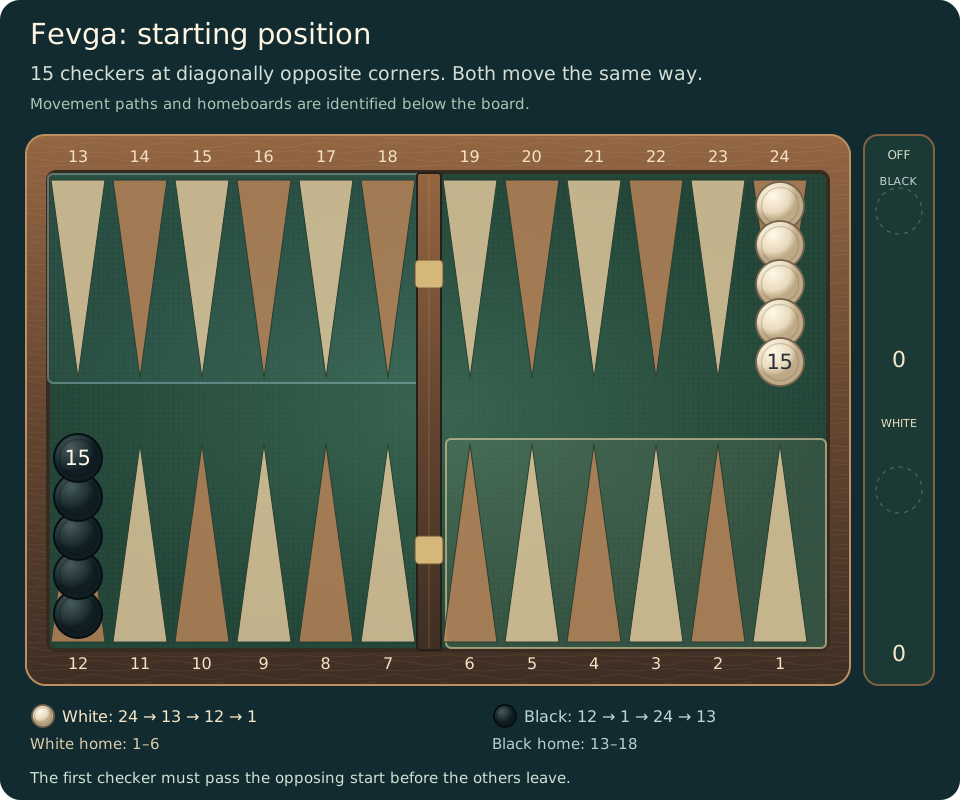
Both players start with fifteen checkers together, at diagonally opposite corners. Both travel counterclockwise. The goal is to complete your own route, bring every remaining checker into your home board and bear them all off.
Our diagrams keep White's numbers fixed. White starts on 24, moves 24→23→…→1 and finishes in 1–6. Black starts on 12, moves 12→11→…→1→24→…→13 and finishes in 13–18. Black's home is therefore different from its home in Portes and Plakoto.
If counting from your own finish, each player's home is their own 1–6 and their start is their own 24. Do not apply both players' relative numbers to the same fixed diagram. The examples here always use White's printed numbers.
Who starts?
For the first game, each player rolls one die. Ties are rerolled. The higher roller starts by rolling two fresh dice; the opening contest is not the first playable roll. In a continuing match, the winner of the previous game starts the next. Here, a drawn game and a new rematch both lead to a fresh opening contest.
Move only the first checker until it passes the opponent's start
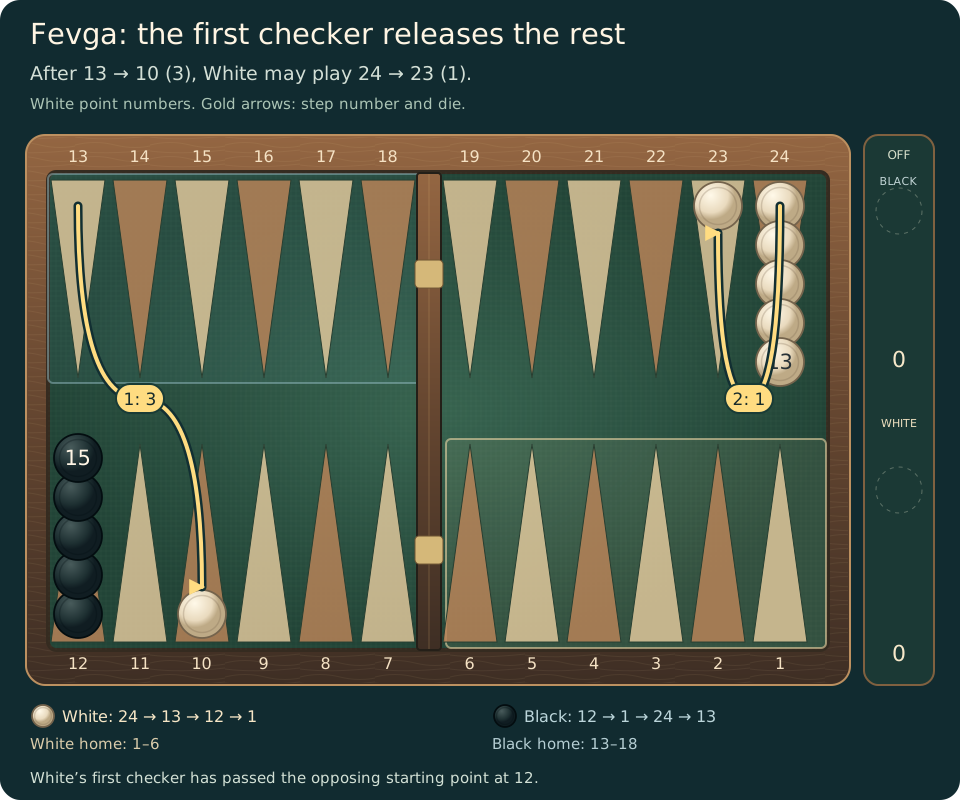
At the beginning, you must keep moving a single checker. You may not move another until this first checker has passed the opponent's starting point. Merely reaching that point is not enough, even if it is empty.
For White, the opposing start is 12. The first checker must reach 11 or lower, a journey of at least thirteen steps from 24. Once it crosses, any remaining die in that same turn may move another checker.
A double does not cancel this restriction. In the starting position, a 6–6 lets White move 24→18 once. The next six would land on the occupied Black start at 12. The first checker cannot continue, and no second White checker is released yet, so the other three sixes cannot be played.
How to use the dice
A roll of 5 and 1 gives one five-point move and one one-point move. You may move two checkers or move the same checker twice. In the latter case, both the intermediate point and the final point must be legal. You cannot jump a blocked landing by treating the dice as a single six.
- Use both dice when possible. Look at both orders. You cannot choose a move that wastes a die if another legal sequence uses both.
- If only one die can be used, use the higher one when either value is individually playable. If only the lower value is legal, use that one.
- Doubles give four moves. A 3–3 provides four threes. Play all four if possible, otherwise the greatest number the position allows.
- Pass only when no move is legal. A bad-looking move is still compulsory if it is the only legal one.
One opposing checker closes a point
Land only on empty points or your own checkers. A single opponent is enough to block a landing. There are no hits, pins or checkers on the bar. You may pass over an occupied point when the landing for that individual die is legal.
Because a lone checker is safe from capture, spreading checkers can close more points. It can also leave you with fewer moves: consider which of your own checkers will still have somewhere to go on a later roll.
The two restrictions on six-point primes
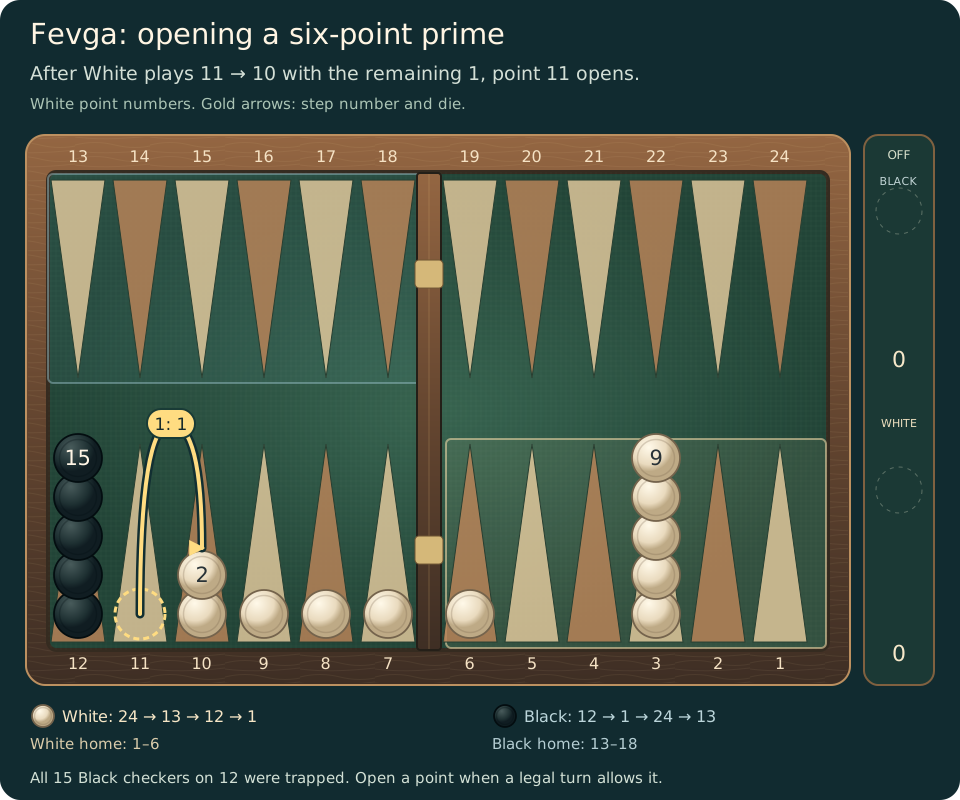
Six consecutive points occupied by your checkers form a prime, or exaporto. An opposing checker immediately behind it cannot cross in one move: every possible die landing is blocked. Fevga places two limits on this:
- You cannot occupy all six points of your own starting quadrant. For White these are 19–24; for Black they are 7–12. Here, this is checked after every die, so you cannot close the sixth point temporarily and open it again later in the turn.
- If all fifteen opposing checkers gather on the single point immediately behind your prime, you must open a point when your roll allows it. Here, the turn must finish with an opening whenever a legal sequence can achieve one. Use the greatest number of dice possible among such opening sequences. If no sequence can open the prime with that roll, play the ordinary legal moves; the obligation remains.
The second restriction needs all fifteen opposing checkers on that one point. A few trapped checkers do not by themselves trigger it. Other primes are allowed; this site does not add a separate ban on a prime in the opponent's starting quadrant.
Bearing off
You may start removing checkers when every checker you still have on the board is in your home board. Checkers already borne off stay out. In your own numbering, home consists of points 1–6.
- An exact die can remove a checker from the matching point: a 4 can bear off from your 4-point.
- You may use that die for another legal move instead, provided you still meet the compulsory-dice rules.
- An oversized die may remove a checker only from your farthest occupied point. With checkers on your 5- and 2-points, a 6 can remove from 5, but not from 2.
Using the most dice still comes first. With fourteen checkers already off, one on your 3-point and a roll of 1 and 3, play 3→2 with the 1, then bear off with the 3. Removing the last checker directly with the 3 would leave a playable die unused.
Count toward your own finish. White bears off past printed point 1, while Black bears off past printed point 13. Neither player takes a second lap around the board.
Winning and points
Bearing off all fifteen checkers wins the game. You score 1 point if the opponent has borne off at least one checker, or 2 points if they have borne off none. The two-point win is called mars, or gammon. There is no three-point backgammon and no doubling cube.
You can play this game on its own or as part of Trio, a cycle of Portes, Plakoto and Fevga.
For the other two games, read Portes and Plakoto, or return to the Tavli guide. Rule reference: Backgammon Galore: Fevga. The timing of the prime checks is stated explicitly above because descriptions and house rules differ.